On 14 July 2026 the European Commission rewrote Article 11(2) of the Batteries Regulation and the list of products that escape the user-replaceable battery rule went from two entries to eight. The rule itself still starts on 18 February 2027, but if you have been telling customers that everything sold in the EU will have a battery they can swap, the law no longer says that — and for phones and tablets it never did.
This post is built from four primary documents: Regulation (EU) 2023/1542 as published in the Official Journal, the delegated act C(2026) 5031 adopted on 14 July 2026, the Commission guidelines C(2026) 5032 issued the same day, and Regulation (EU) 2023/1670, the ecodesign rule that quietly outranks all of it for handsets. Every number below is linked to its source at the end.
Four outcomes, not two
Almost every English write-up treats this as binary: replaceable, or not. Read the text and there are four distinct outcomes, each with its own legal basis, plus one redirect to a different regulation entirely. Work down the list — the first match wins.
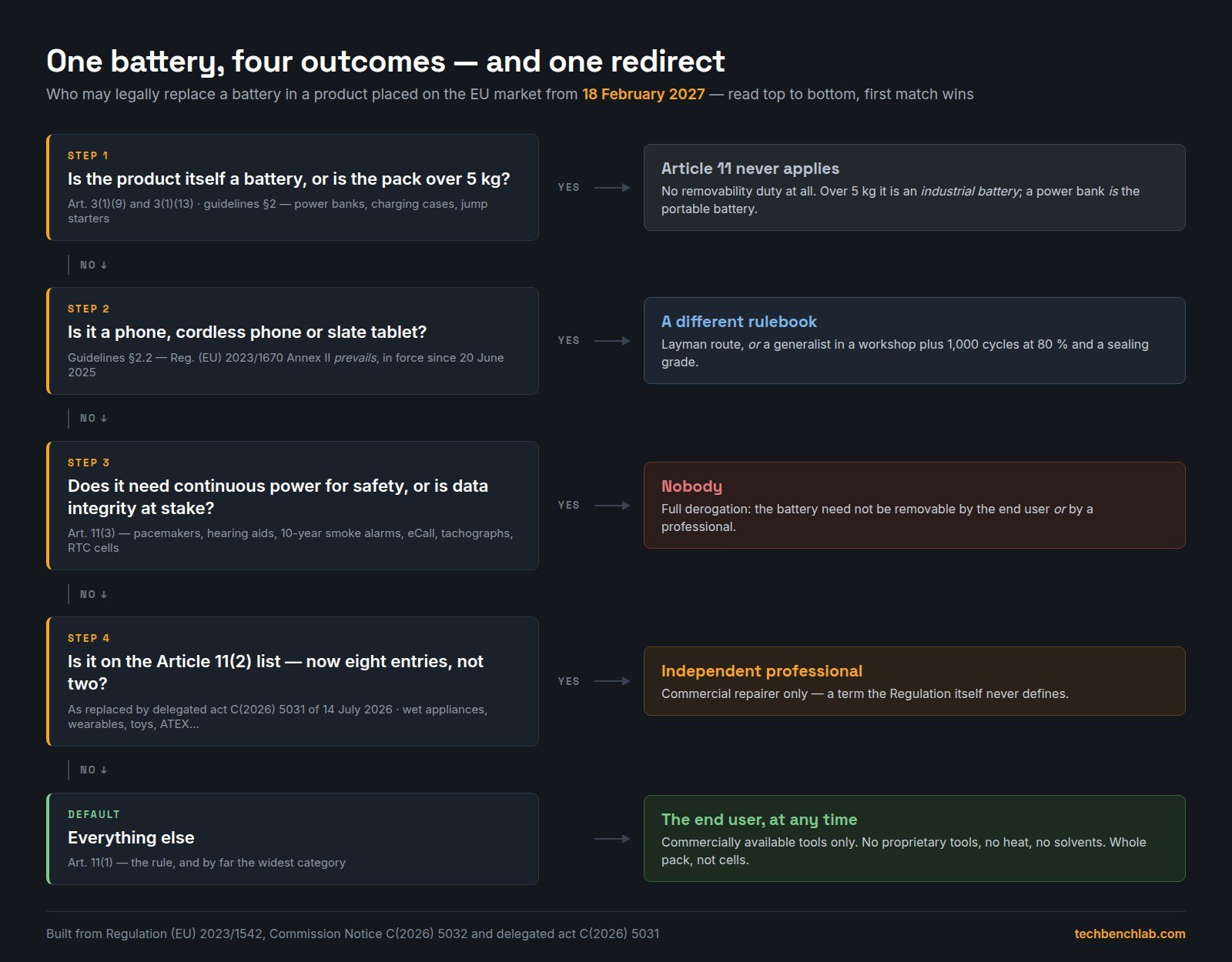
Two of those boxes surprise people. The first is that a product can be out of scope entirely. A “portable battery” under Article 3(1)(9) is sealed, weighs 5 kg or less, and is not an industrial, EV, LMT or SLI battery. Anything heavier that is not one of those vehicle types falls into Article 3(1)(13) and becomes an industrial battery — so a 20 kg portable power station is not covered by Article 11 at all. The guidelines go further and add a case that was not in the January 2025 version: where the product’s main function is delivering energy to other products, the product is the battery. Power banks, charging cases for earbuds and hearing aids, and car jump starters are named, and for them “Article 11 would not be applicable in the first place.”
The second surprise is the “nobody” box. Article 11(3) is a full derogation, not a downgrade: where continuity of power is needed for safety, or where the product’s main function is collecting and supplying data and integrity is at stake, the battery need not be removable by the end user or by a professional. The guidelines name what lands there, and the list is longer than most people expect.
| Reason under Article 11(3) | Products the guidelines name |
|---|---|
| Life-saving or life-sustaining | Pacemakers, implantable defibrillators and pulse generators; surgical utensils; endoscope washer disinfectors |
| Lifetime set by medical reasons | Hearing aids |
| Safety devices under the Construction Products Regulation | Smoke, fire, CO and gas alarms designed for 10 years of uninterrupted operation; fixed fire-fighting equipment; escape doors |
| Automotive continuity | eCall, TPMS, anti-theft alarms, battery temperature warning, Intelligent Speed Assistance, tachographs, event data recorders |
| Continuous data collection | Professional weather stations; cold-chain temperature and humidity sensors; on-body glucose biosensors; quantum key distribution |
| Volatile memory and clocks | CMOS and real-time-clock cells; toll on-board equipment; point-of-sale and credential hardware |
The list that went from two to eight
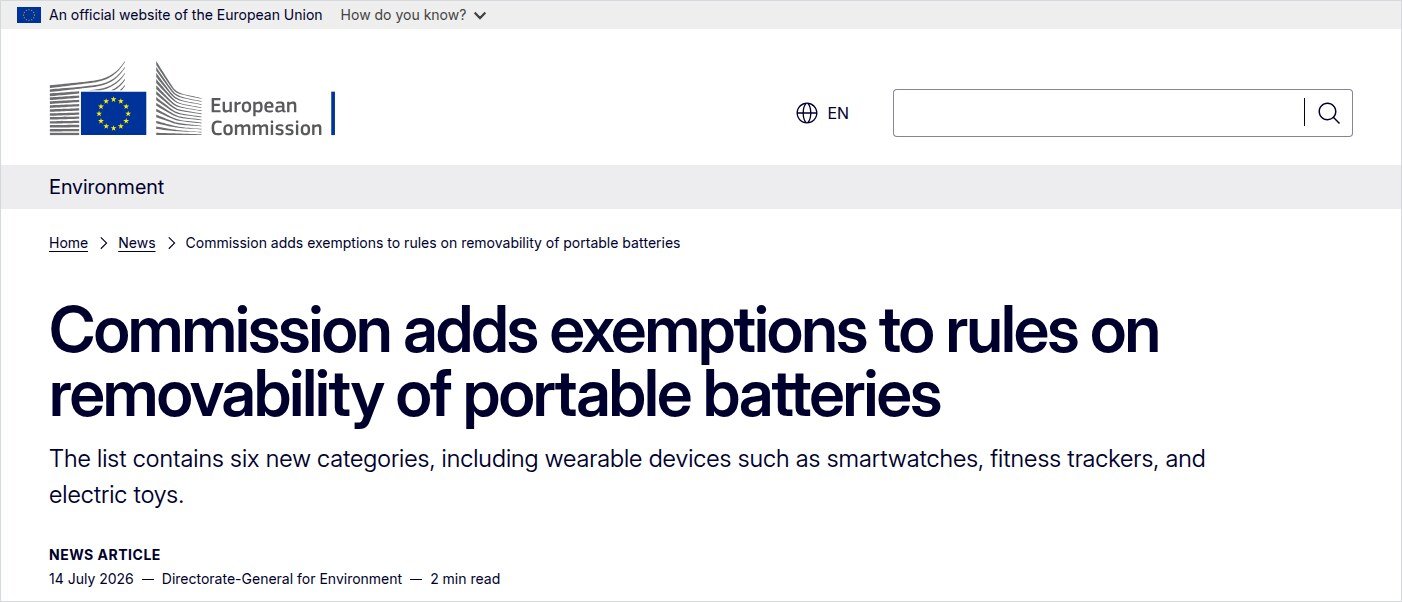
The delegated act does not amend Article 11(2) — it replaces the whole paragraph. The Commission’s own announcement puts the count plainly: “six new product categories”.
| Article 11(2), as replaced on 14 July 2026 | Status |
|---|---|
| (a) Appliances, including wearable devices, designed to operate primarily under splashing water, water streams or immersion, and intended to be washable or rinseable | Widened — the three words on wearables are new |
| (b) Professional medical imaging and radiotherapy devices; in vitro diagnostic devices | Unchanged since 2023 |
| (c) Wearables whose safety, durability or water resistance would be compromised by user access, and which are either too small for safe handling or rely on a compact sealed enclosure | New |
| (d) Electric toys with rechargeable batteries — until 31 July 2030 only | New, temporary |
| (e) Wireless thermometer probes designed for food contact | New |
| (f) Products in scope of Article 1 of the ATEX Directive 2014/34/EU | New |
| (g) On-body systems for subcutaneous drug delivery | New |
| (h) Roof-mounted telematics for agricultural and construction machinery | New |
Every entry except (b) carries a condition in the closing sentence: the derogation applies “only where such derogation is required to ensure the safety of the user and the appliance”. A manufacturer does not get to tick the box because its product is a smartwatch; it has to hold evidence, in the product documentation, that user replacement would compromise safety and that redesign is not possible.
The toy entry is dated because it is a bridge. Regulation (EU) 2025/2509, the new toy safety rule, applies from 1 August 2030 and carries its own battery-access provision — so the derogation stops the day before, on 31 July 2030.
One caveat that matters if you are quoting this to anyone: the delegated act is adopted but not yet in force. Under Article 89(6), it enters into force only if neither the European Parliament nor the Council objects within three months of notification, extendable by two. The Council cover note records the date of receipt as 14 July 2026, which puts the ordinary deadline in mid-October 2026. It then takes effect 20 days after publication in the Official Journal.
Why your phone is not in any of those boxes
This is the part that gets misreported hardest. The guidelines say it in one sentence: for products covered by Regulation (EU) 2023/1670, the removability obligations in that regulation’s Annex II prevail over Article 11. Phones and tablets have been under their own ecodesign rule since 20 June 2025, and it offers the manufacturer a choice.
| Annex II class | Route (i) — layman | Route (ii) — the alternative | Sealing demanded on route (ii) |
|---|---|---|---|
| A. Mobile phones other than smartphones | Layman, in a use environment, basic or supplied tools; fasteners reusable or resupplied | Generalist in a workshop with commercially available tools, plus ≥83 % capacity after 500 cycles and ≥1,000 cycles ending at ≥80 % | Dust tight + immersion to 1 m for 30 min |
| B. Smartphones | Same as A | Same as A | Dust tight + immersion to 1 m for 30 min |
| C. Cordless phones | Layman, use environment, basic or supplied tools | None — there is no alternative route | — |
| D. Slate tablets | Same as A | Same endurance thresholds as A | IP42 only |
Three things fall out of that table. A glued-in smartphone battery stays perfectly legal after February 2027, provided the maker meets route (ii) — that is not a loophole, it is the written rule. The desk cordless phone has the strictest battery rule of the four, because it has no opt-out at all. And a tablet buys the same exemption a phone does for IP42: protection against solid objects over 1 mm and dripping water at a 15° tilt. That is the cheapest sealing requirement in the set, and it is nowhere near the immersion test a phone has to pass.
Spare parts run on two clocks too. Article 11(7) of the Batteries Regulation requires batteries to stay available for five years after the last unit of the model is placed on the market. Regulation 2023/1670 requires seven years after end of placement for phones and tablets, with software tools for serialised parts handed over within three working days of a request.
The part nobody covers: “independent professional” is undefined
Article 3(1) of the Batteries Regulation carries 68 numbered definitions. “Independent operator” is number 23. “Independent aggregator” is in there. “Independent professional” is not — and it is the term on which all eight derogations and the entire LMT rule depend.
The guidelines admit the gap in §3.1 and fill it by borrowing from Annex II of the ecodesign regulation: independent operators with the technical competence and qualification to repair the product, “conducting their business on commercial basis and/or in commercial premises”. Read that last clause slowly. The hobbyist with a good bench and a hot air station is outside the definition; the shop down the road is inside it. Suggested proof of standing is a national repairer registration where one exists, or registration or training with the manufacturer.
Two further details worth carrying into an argument with a distributor. Article 11(1) covers the whole battery only, never individual cells — but Article 11(5) extends the duty down to cell level inside the pack for LMT batteries, which is what a bike or scooter battery under 25 kg is. So a repairer can point to the law when asking for cell-level serviceability on an e-bike pack and cannot when asking for the same on a phone. And Article 11(8) bans using software to impede replacement; the guidelines name the practice — parts pairing — and allow a non-original-battery notice on screen only if it affects no functionality of the device or the battery, and not the user experience either.
Limits, and the errors to avoid
The guidelines are not binding. The document says so on page 2: it reflects the Commission’s views, and final interpretation belongs to the Court of Justice. In practice the national market surveillance authority decides, and it will be reading the same text you are.
An IP rating alone proves nothing. The guidelines do map the words in Article 11(2)(a) onto IEC 60529 — “splashing water” is IPX4, “water streams” is IPX5 and IPX6, “water immersion” is IPX7 — but they state explicitly that the rating is indicative only. The derogation needs evidence on all five indicators, including that the appliance operates in that environment for the majority of its active service and that redesign is impossible. A toothbrush running on ordinary portable cells is named in the guidelines as an example of a wet appliance that should still be user-serviceable.
Nothing here is retroactive. The obligations bite on products placed on the market from 18 February 2027; the guidelines confirm the spare-parts duty does not reach back to units placed before that date. The laptop on your bench today is governed by whatever applied when it was sold — and by the separate spare parts and repair obligations already running, which are a different instrument from this one.
Do not read “tool-free” into the rule. Article 11(1) permits commercially available tools. What it forbids is proprietary tools, thermal energy and solvents — which is why adhesive with a pull tab survives the test and a heat-and-pry battery does not. Specialised tools that are specific to a product group and not patented are allowed only if the manufacturer ships them free with the product.
In the US the equivalent duties come from state law, scattered across eight statutes with their own dates — that map is in our state-by-state tracker.
Sources
- Regulation (EU) 2023/1542 concerning batteries and waste batteries — Articles 3, 11, 89 and 96 — Official Journal L 191, 28.7.2023
- Commission Delegated Regulation C(2026) 5031 final of 14.7.2026, replacing Article 11(2) — DG Environment
- Commission Notice C(2026) 5032 final of 14.7.2026, guidelines under Article 11(9) — PDF, DG Environment
- Commission Notice C/2025/214 of 10.1.2025, the superseded first version of the guidelines — Official Journal C series
- Council of the EU cover note 12056/26 of 17 July 2026, recording notification of the delegated act — PDF
- Commission Regulation (EU) 2023/1670, ecodesign for smartphones, other mobile phones, cordless phones and slate tablets — Official Journal L 214, 31.8.2023
- Regulation (EU) 2025/2509 on the safety of toys — Official Journal
- Regulation (EU) 2024/3110, the Construction Products Regulation cited for alarm and detection equipment — Official Journal
- “Commission adds exemptions to rules on removability of portable batteries”, 14 July 2026 — DG Environment news
Checked 25 September 2026. The delegated act was in its scrutiny period on that date; if you are reading this later, confirm whether it has been published in the Official Journal.