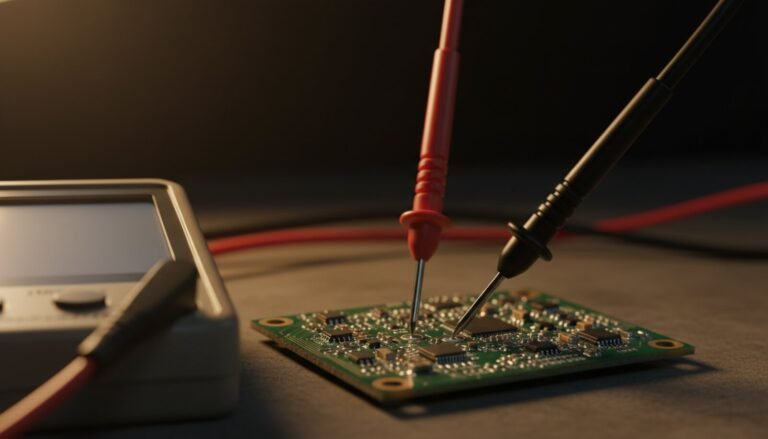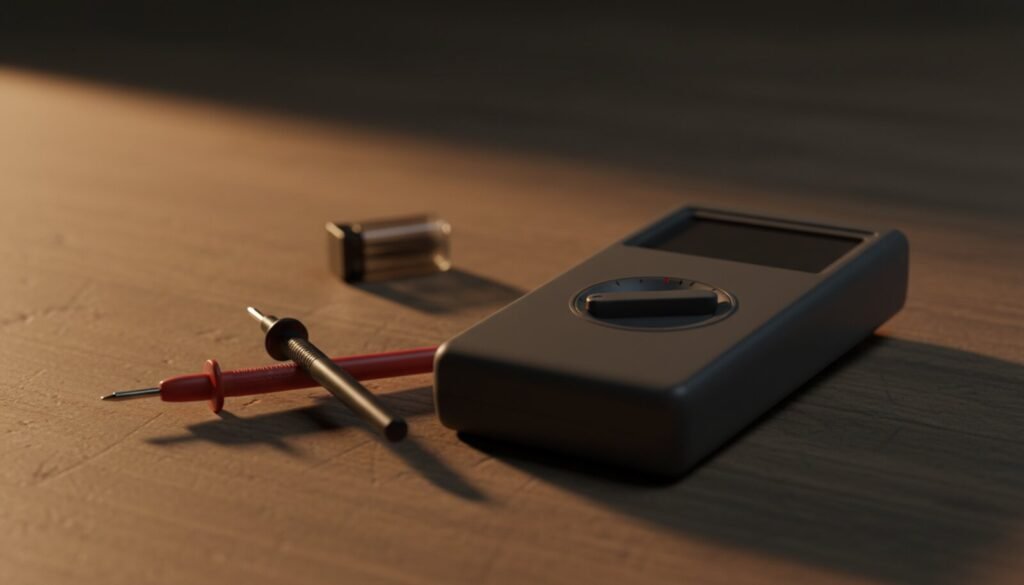
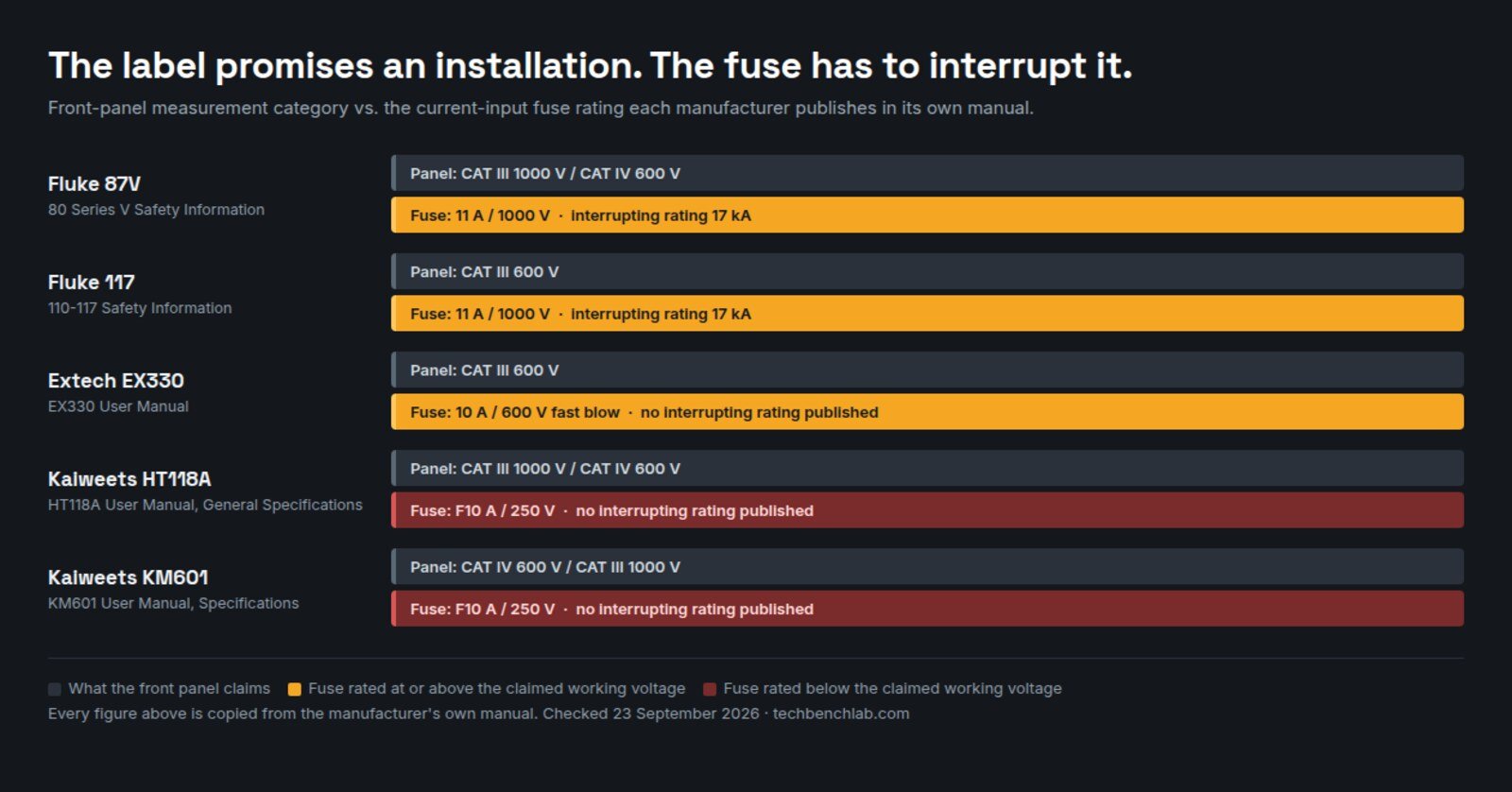
Two multimeters on this page carry the same promise on the front panel — CAT III 1000 V, CAT IV 600 V — and the manuals disagree about what is behind it: one specifies current-input fuses rated 1000 V with a 17 kA interrupting rating, the other specifies fuses rated 250 V. Both statements come from the manufacturers’ own documents, and the second one is printed a few pages after a drawing of the meter’s own front panel showing the CAT IV claim.
This is not a review and there is no bench here: every figure below is copied from a published manual, a manufacturer’s spec sheet, or a certificate record you can pull up yourself. What follows is the check anybody can run before buying, in about three minutes. (All sources checked 23 September 2026.)
What a CAT number actually claims
A measurement category is not a quality grade. It says where in an electrical installation the instrument is allowed to be connected, because the further upstream you go, the more transient energy is available to blow through the meter and into your hands. Fluke’s safety sheet states the three definitions in the standard’s own words:
- CAT II — “test and measuring circuits connected directly to utilization points (socket outlets and similar points) of the low-voltage MAINS installation.”
- CAT III — “circuits connected to the distribution part of the building’s low-voltage MAINS installation.”
- CAT IV — “circuits connected at the source of the building’s low-voltage MAINS installation.”
The voltage that follows the category is the working voltage, not the transient the instrument has to survive. The pairing is what matters: CAT IV 600 V is a harder problem than CAT III 1000 V, which is why meters that claim both list them separately.
Two documents on this page name the standard they were built to. Fluke’s 80 Series V safety information lists “IEC 61010-1: Pollution Degree 2, IEC 61010-2-033: Measurement CAT III 1000 V / CAT IV 600 V”. The Extech EX330 manual says the meter is protected “by double insulation per EN61010-1 and IEC61010-1 3rd Edition (2010) to CAT III 600V; Pollution Degree 2”. Note the second part number in the Fluke line — 61010-2-033 is the particular standard for hand-held multimeters, and a meter whose manual never mentions it has told you something.
The fuse is where the claim gets tested
A fuse has two ratings that matter and both are about interruption, not about the current at which it opens: the voltage it can interrupt at, and the prospective fault current it can interrupt — the interrupting rating. Fluke publishes both, and warns in the same document: “Replace a blown fuse with exact replacement only for continued protection against arc flash.” Cheap meters publish the amps and leave the rest out.
| Meter | Front-panel claim | Standard named in the manual | Current-input fuse, as published |
|---|---|---|---|
| Fluke 87V | CAT III 1000 V / CAT IV 600 V | IEC 61010-1, IEC 61010-2-033 | 0.44 A / 1000 V, IR 10 kA · 11 A / 1000 V, IR 17 kA |
| Fluke 117 | CAT III 600 V, 10 A | IEC 61010-1, IEC 61010-2-033 | 11 A / 1000 V, IR 17 kA (PN 803293) |
| Extech EX330 | CAT III 600 V | EN 61010-1, IEC 61010-1 3rd ed. (2010) | 500 mA / 600 V and 10 A / 600 V fast blow; no IR published |
| Kaiweets HT118A | CAT III 1000 V / CAT IV 600 V | none named | F600 mA / 250 V and F10 A / 250 V; no IR published |
| Kaiweets KM601 | CAT IV 600 V / CAT III 1000 V | none named | F600 mA / 250 V and F10 A / 250 V; no IR published |
The HT118A is the clearest case because the contradiction is inside one document. Page 18 of its user manual carries a line drawing of the meter, and the drawing shows “1000V CAT III / 600V CAT IV” next to input jacks labelled “MAX 10A/250V” and “MAX 600mA/250V”. Page 24 confirms it in the General Specifications table: Safety / Compliances: CATIII 1000V, CATIV 600V, then Fuse protection: mA: F600mA /250V Fuse; 10A: F10A /250V Fuse. The KM601, the company’s higher-end model, prints the same pair of 250 V fuses beside “CAT. IV 600V ; CAT. III 1000V”.
The Extech is the useful middle of the table: no third-party mark, “Approvals: CE” and nothing else — but fuses specified at 600 V, matching the 600 V category on the panel. Self-declared does not automatically mean wrong. It means unverified, and the fuse line is one of the few places where the specification either lines up or does not.
Who has a certificate you can look up
TÜV Rheinland publishes its certificates in a public database, Certipedia, and it is the only one of the big certification bodies that answers an ordinary search request without a login. Searching “multimeter” on 23 September 2026 returns 363 results. Paged through the site’s own JSON endpoint and deduplicated, that is 358 product certificates issued between 1995 and 2026, plus 31 quality-mark entries.
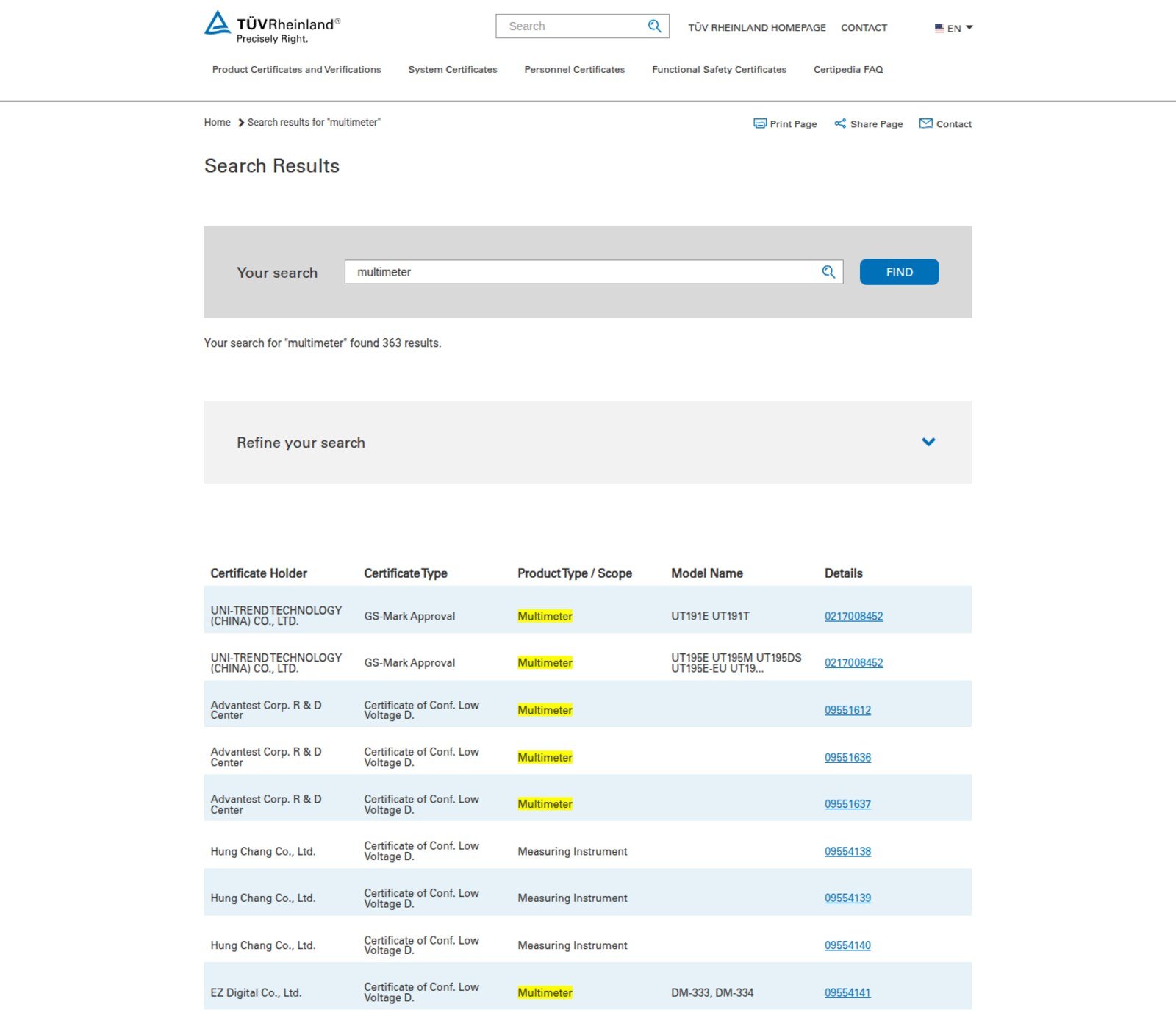
Of those product certificates, 28 are GS-Mark approvals for multimeters — the German mark that does require a third party, with a certificate number you can type into the search box. Fifteen of them, with the models each one covers:
| Certificate | Models covered | Issued |
|---|---|---|
| 50546073 | UT191E, UT191T (UNI-Trend) | 2022-06-20 |
| 50546092 | UT195E, UT195M, UT195DS… (UNI-Trend) | 2022-06-20 |
| 50546101 | VC-440 E, VC-450 E, VC-460 E (Conrad / Voltcraft) | 2022-06-20 |
| 50575342 | DT-9919, DT-9918, DT-9917 (Shenzhen Everbest) | 2023-02-22 |
| 50576327 | 47 3320 9917 (HOLEX / Hoffmann) | 2023-03-06 |
| 50582320 | PeakTech 3355, PeakTech 3360 | 2023-04-24 |
| 50592105 | DT-960, DT-960B, DT-960BL (Everbest) | 2023-07-25 |
| 50587406 | DT-116, DT-118, DT-118B, DT-119 (Everbest) | 2024-01-04 |
| 50618075 | DT-5505, DT-5500, DT-5503 (Everbest) | 2024-02-05 |
| 50620815 | EM3801 (Eastern Technology) | 2024-02-28 |
| 50639883 | EM390B, EM391B, EM392B, EM393B (Eastern Technology) | 2024-07-18 |
| 50639891 | 1070 DMM (PeakTech) | 2024-07-18 |
| 50635406 | PeakTech 3440, PeakTech 3441 | 2024-07-31 |
| 50645587 | PDAM 300 B1 (Kompernaß, sold through Lidl) | 2024-09-11 |
| 50659036 | EM830, EM830B, EM830D (Eastern Technology) | 2024-12-24 |
Read that list next to the price of the hardware and the tidy story falls apart. A supermarket meter sold by Lidl has a GS-Mark on file. So does the EM830 — the yellow-cased design that the whole DT-830 clone family is copied from. Meanwhile, searching the same database for the brands that dominate an Amazon search returns nothing at all: Aneng 0, Kaiweets 0, Owon 0, AstroAI 0, Zoyi 0, Mustool 0. Absence of a record is not proof of an uncertified product — those makers may hold certificates from bodies whose databases are not public — but it is the end of the road for anyone trying to verify the claim from outside.
The part nobody covers: 46 % of those certificates are EMC
Break the 358 product certificates down by type and the picture changes again:
| Certificate type | Count | What it covers |
|---|---|---|
| Certificate of Conformity EMC | 157 | Electromagnetic compatibility |
| Conformity, Low Voltage Directive | 105 | Electrical safety |
| GS-Mark Approval | 28 | Electrical safety, third party required |
| Certificate of Conformity | 21 | Varies by scope |
| CB Certificate (incl. Japan) | 20 | Electrical safety, IECEE scheme |
| UK Electrical Equipment (Safety) Regs 2016 | 11 | Electrical safety |
| US + Canada Certificate | 9 | Electrical safety, North America |
| UK Electromagnetic Compatibility Regs 2016 | 7 | Electromagnetic compatibility |
Counting both EMC categories, 164 of 358 certificates (46 %) say nothing whatsoever about surviving a transient or interrupting an arc. They say the instrument does not emit too much radio noise and is not upset by the noise around it. A seller who answers “it’s TÜV certified” is, statistically, as likely to be holding an EMC certificate as a safety one — and the certificate number tells you which, in one click.
The database is also live, not a museum: 85 of the 358 were issued in 2024 or later, and the three most recent are PeakTech 2705 and 2695 (10 September 2026) and PeakTech 2700 (17 September 2026), six days before this was written.
Why the CE mark tells you nothing here
The European Commission’s own Low Voltage Directive page is blunt about it: “The new LVD does not require notified bodies to assess if products to be placed on the market comply with the applicable EU legislation. The manufacturer alone is responsible for determining this by carrying out conformity assessment procedures.” CE is a declaration, and a CAT rating printed beside it is part of that declaration.
The same page carries a warning aimed at exactly the thing you see in marketplace listings — the certificate image with an impressive logo on it: “under EU law, voluntary or other additional certificates are not a recognised means to prove compliance… Voluntary certificates can create the impression that the product conforms with applicable EU harmonisation legislation, although such certificates are not issued by an authorised body.”
How to check any meter in three minutes
- Find the manual before you buy, not after. If the maker does not host one, that is the answer.
- Look for 61010-2-033. A meter built to the hand-held multimeter standard normally says so. “Designed to comply” is weaker than a named standard, and a named standard is weaker than a certificate number.
- Read the fuse line. Compare the fuse voltage with the working voltage on the panel. 250 V fuses under a 600 V or 1000 V claim is the tell. An interrupting rating in kA is a good sign; most manuals in this price class have never printed one.
- Search the certificate. Certipedia takes a brand, a model or a certificate number. If the seller gave you a number, check that it exists, that it names your model, and that its type is a safety type and not EMC.
- Decide what you are actually doing. For DC rails on a dead laptop board, none of this is in play — see our piece on which multimeter specs matter for board repair. The moment the probes touch anything fed from the mains, it is.
Limits of this check
Three honest caveats. First, nothing here was measured; it is a documentation audit, and a published number is a promise, not a test result. Second, Certipedia covers TÜV Rheinland only. UL’s Product iQ, CSA Group’s listing and TÜV SÜD’s certificate database all refused anonymous requests from this machine, and Intertek’s ETL directory did not resolve at all — so a meter certified by any of them looks identical, from outside, to a meter certified by nobody. Third, the GS-Mark list above is what the database returned for the word “multimeter”; a certificate filed under a different product wording would not appear.
What survives all three caveats is the fuse line. It is published, it is specific, and it is the one number in a cheap meter’s manual that the marketing department did not write.
Sources
- Fluke, 80 Series V Digital Multimeter Safety Information (CAT definitions, fuse ratings, CSA Group statement)
- Fluke, 110-117 Safety Information and 114/115/116/117 Detailed Specifications
- Extech, EX330 User Manual (Internet Archive snapshot, extech.com blocks datacentre addresses)
- Kaiweets, manuals and downloads — HT118A User Manual pages 18 and 24; KM601 User Manual page 31
- TÜV Rheinland, Certipedia search for “multimeter”
- European Commission, Low Voltage Directive (LVD) — “Notified bodies” and “Unregulated certificates warning”
Related on Tech Bench Lab
- Choosing a multimeter for board repair: which specs actually matter
- How to test resistors, diodes and transistors on a board
- How to test a capacitor: bulging, shorted, and ESR
- Bench power supply diagnostics: current draw and short hunting
- Hot air stations compared by airflow and the numbers that matter