We pulled the official specification for twelve hot air rework stations — manufacturer pages and service manuals only — and put the airflow numbers side by side. They are published in six different conventions, one of them is not a flow rate at all, and only two manufacturers tell you the condition under which the number was taken.
That matters because airflow, not temperature, is what actually moves heat into a joint. If you are shopping by “L/min”, you are comparing numbers that were not measured the same way — and in one case, a number that was never litres per minute in the first place.
What the twelve manufacturers actually publish
Everything below is quoted from the manufacturer’s own page or manual, in the manufacturer’s own units. Nothing here is a retailer listing, and nothing is converted yet.
| Station | Temperature range (official) | Airflow, as published | Stated condition | Power |
|---|---|---|---|---|
| JBC JNA (high-precision) | 150–450 °C | 0.15–2.5 SLPM | Standard litres | 70 W |
| JBC TESE / TET | 150–450 °C | 2–17 SLPM | Standard litres | 300 W |
| JBC JTSE / JTT | 150–450 °C | 5–50 SLPM | Standard litres | 700 W |
| PACE ST 325 | 149–482 °C | 5–20 SLPM | Standard litres, “measured at heater” | 750 W |
| Thermaltronics TMT-HA100 | 100–450 °C | 10 L/min max | None; diaphragm pump | — |
| Thermaltronics TMT-HA200 | 100–480 °C | 35 L/min max | None; turbine fan | 600 W |
| Weller WTHA 1 | 50–600 °C | 5–60 l/min at 20 °C 5–110 l/min at 300 °C |
Temperature stated | 750 (900) W |
| Hakko FR-810B | 50–600 °C | 5–115 L/min (dial 1–9) | “Rated as free flowing” | 1,100 W at 220 V |
| Hakko FR-811 | 50–600 °C | 5–115 L/min (1–100 %) | Free flowing | 1,100 W at 220 V |
| Hakko FR-702 | 50–600 °C (air) | 5–115 L/min | Free flowing | — |
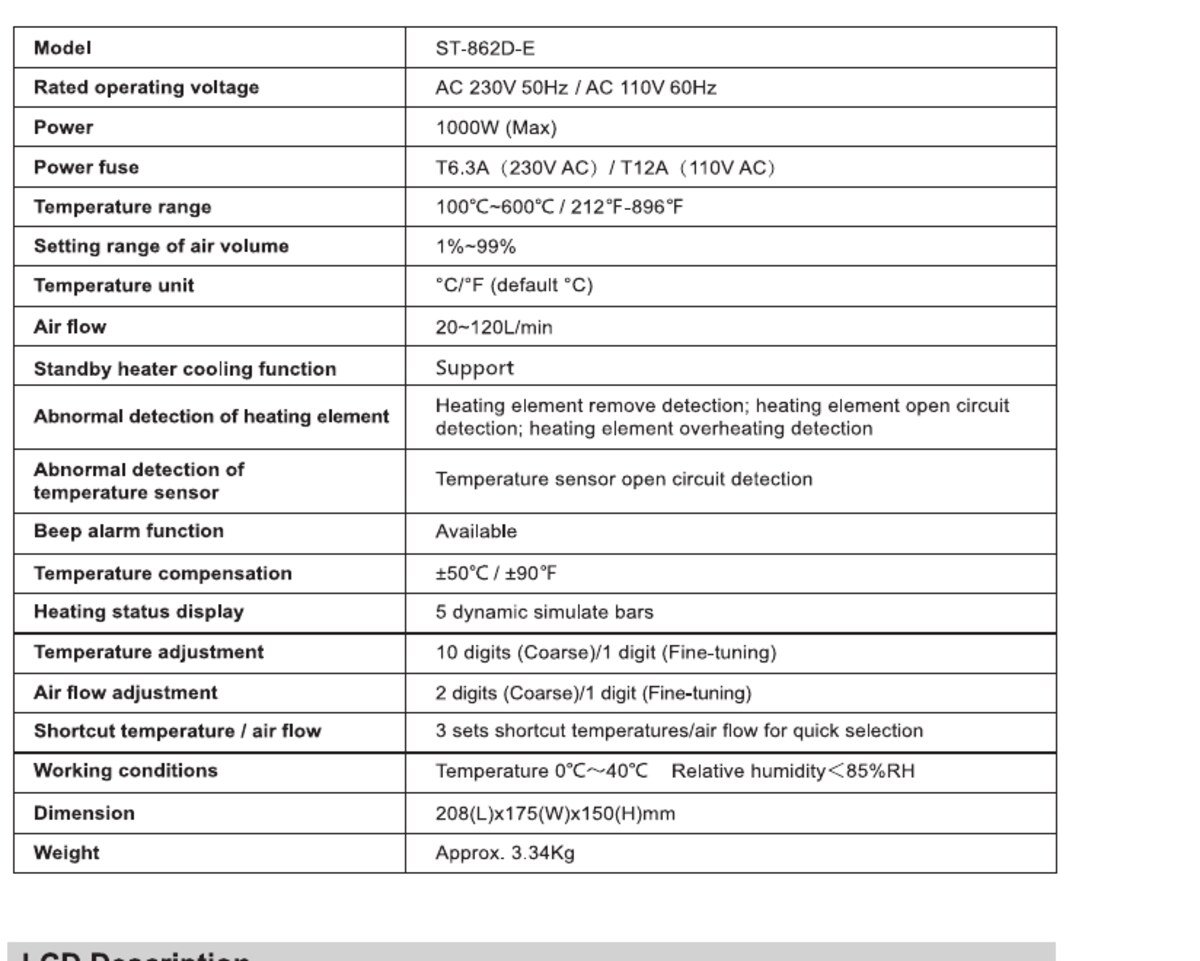
| Atten ST-862D | 100–600 °C / 212–896 °F (see below) | 20–120 L/min; panel reads 1–99 % | None | 1,000 W max |
| Quick 861DW | 100–500 °C | 1–120 “class” | Not a flow rate | 1,000 W |
Six conventions, one column heading
Read down that airflow column and you are reading six different things:
- SLPM (JBC, PACE) — standard litres per minute, normalised to a reference condition of pressure and temperature. It is a mass flow dressed as a volume.
- l/min at a stated temperature (Weller) — the only maker in the set that publishes the same station’s flow twice, at two temperatures.
- L/min free-flowing (Hakko) — measured with nothing on the end. Hakko’s own footnote says so: “Airflow capacity is rated as free flowing. Restrictions created by various nozzles may reduce the maximum airflow capacity.”
- L/min, no condition given (Atten, Thermaltronics) — a bare number.
- Percent (Atten’s display reads 1–99 %, Hakko’s FR-811 reads 1–100 %) — a setting, not a quantity.
- “Class” (Quick) — a step on a dial. More on that below.
The part nobody covers: hot air is roughly twice the volume of cold air
Weller publishes both numbers for the WTHA 1, and that accidentally hands everyone the conversion factor. From the official manual: 5–60 l/min at 20 °C, and 5–110 l/min at 300 °C. Same turbine, same station, same air — 110 ÷ 60 = 1.83×.
That is what the ideal gas law predicts. Heating air from 20 °C (293 K) to 300 °C (573 K) at constant pressure expands it by 573 ÷ 293 = 1.96×. Weller’s measured ratio comes in just under that, which is what you would expect once the blower sees some back-pressure.
So a flow figure with no reference temperature carries a two-fold ambiguity. Run the correction across the set and the league table rearranges itself:
| Station | Published | Reference stated? | Estimated flow leaving the nozzle at 300 °C |
|---|---|---|---|
| Weller WTHA 1 | 60 l/min at 20 °C | Yes | 110 l/min — published by the maker |
| JBC JTSE | 50 SLPM | Standard, but which standard is not stated | ≈98–105 L/min |
| PACE ST 325 | 20 SLPM at the heater | Standard, unspecified | ≈39–42 L/min |
| JBC TESE | 17 SLPM | Standard, unspecified | ≈33–36 L/min |
| Hakko FR-810B | 115 L/min free flow | No temperature given | 115 if already hot, ≈225 if cold |
| Atten ST-862D | 120 L/min | No | Same 2× ambiguity |
| Thermaltronics TMT-HA200 | 35 L/min | No | Same 2× ambiguity |
The arithmetic is ours, and the assumption is stated: standard litres referenced to 0 °C give ×2.10, referenced to 20 °C give ×1.96, and neither JBC nor PACE says which they use — hence the ranges rather than single figures.
The practical upshot is the interesting part. JBC’s JTSE looks like a 50 against Hakko’s 115 — less than half the station. Normalised to hot air at the nozzle, 50 SLPM is about 100 L/min, which sits next to Weller’s 110 and Hakko’s 115. Three stations that look wildly different on a spec sheet are plausibly moving the same order of air.
The Quick 861DW does not have a 120 L/min spec
Search for this station and every listing, review and distributor says 120 L/min. One European distributor has it in the product URL. The manufacturer does not say it anywhere.
Quick’s own English specification table reads “Air volume range: 1 ~ 120 class”. The Chinese page for the same product is unambiguous: 「风量档位范围 1~120级」 — 风量档位 is the air-volume step position, and 级 is a level. It is a 120-step setting range on the front panel. It is not litres, and it was never litres.
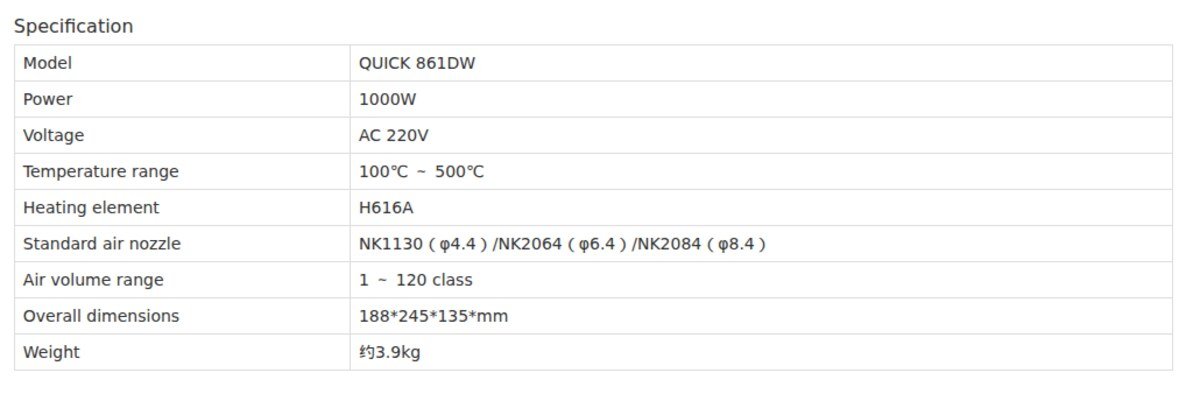
This is a translation artefact that hardened into a spec. A number from a dimensionless setting scale got a unit bolted onto it somewhere in the retail chain, and it has been copied ever since. Quick may well move a lot of air — the station is 1,000 W with a brushless vortex fan, and people who own one like it — but nobody who repeats “120 L/min” is quoting the manufacturer.
The Atten sheet that disagrees with itself
Atten’s ST-862D manual (document CBN034607 rev. F) gives, on one line of the Technical Parameters table: “Temperature range: 100 °C~600 °C / 212 °F-896 °F”.
896 °F is 480 °C, not 600 °C. The two halves of the same cell are 120 °C apart. European distributors list the station as 100–480 °C, which suggests the Fahrenheit column is the honest one and the Celsius figure is a typo that has been shipping for years. The same table gives temperature compensation of ±50 °C, which is a far more useful disclosure than either end of the range.
Other numbers worth having
Things that turned up in the official documents and almost never make it into comparisons:
- Weller publishes a noise figure: 56 dB(A) at 1 m at maximum airflow. Nobody else in the set publishes one, and a turbine at full tilt next to your head for eight hours is a real specification.
- Weller specifies temperature accuracy of ±30 °C on a 900 W professional station. Hot air is not a soldering tip; nobody is holding ±1 °C in a moving air stream, and the honest makers say so.
- Wattage is a mains-voltage artefact. The same Hakko FR-810B is rated 700 W at 100 V and 1,300 W at 240 V. Comparing the wattage of a US-market station against a European one tells you about the socket, not the heater.
- Pump type is published by exactly one maker. Thermaltronics states diaphragm on the HA100 (10 L/min) and turbine on the HA200 (35 L/min) — which is most of the reason for the difference.
- Only two of the eight manufacturers publish a price at all. PACE lists the ST 325 at US$2,305.55 (P/N 8007-0429) and Thermaltronics lists the HA200 at US$241.50 and the HA100 at US$454.25, both on their own sites. For the rest, every price you will find is a reseller’s. We have left those cells empty rather than quote a shop as if it were a manufacturer.
What to compare instead
Given the state of the specs, three things are worth reading off a data sheet and the rest is noise:
- The flow number together with its condition. A station that tells you the measurement condition is telling you it measured. If the condition is missing, assume the generous interpretation was used and discount accordingly.
- The low end of the range, not the high end. Every station in this set will blow a 0402 across the bench at full flow. The useful spec is the minimum: JBC’s JNA starts at 0.15 SLPM, Hakko and Weller start at 5, Atten starts at 20. If you rework small passives and flex cables, the bottom of the range decides whether the tool is usable, and it is the number nobody quotes.
- Nozzle availability, not nozzle count. The flow you get is the free-flow figure minus whatever the nozzle takes back — Hakko is the only maker that admits this in writing, and none of them publish the derated figure.
Everything after that is technique, and technique is where the real temperature control lives: the display reads the heater, not the joint. That argument, with the J-STD-020 reflow numbers behind it, is in our hot air rework station guide. The same “read the instrument’s spec, not the folklore” approach applied to meters is in multimeter specs for board repair, and the mechanical version of it — a spec that quietly limits what you can do — is in SOIC-8 test clips. If hot air is on your bench for chip removal, BGA reballing and bench power supply diagnostics are the neighbouring jobs.
Limits of this comparison
We did not measure any of these stations. Every figure above is transcribed from the manufacturer’s published page or service manual, linked below, and the only arithmetic we added is the gas-law normalisation — which is flagged as an estimate wherever it appears, with its assumption stated. Metcal is absent because okinternational.com and metcal.com both refuse connections from datacentre IPs, and we do not quote specs we could not open ourselves. Retail prices in the US and UK are absent for the same reason: DigiKey, Farnell UK and several EU distributors return 403 to our requests, so the only prices here are the two that manufacturers publish themselves.
If a maker publishes a reference condition we missed, we will correct the table and say so.
Sources
- Hakko FR-810B specifications — hakko.com (also FR-811 and FR-702 spec pages)
- Weller WTHA 1 — product page and operating manual T0055741601 (technical data table)
- JBC JTSE control unit — jbctools.com; TESE; JNA
- PACE ST 325 — product page with list price and manual 5050-0537
- Thermaltronics — TMT-HA200 and TMT-HA100
- Quick 861DW — English product page and Chinese product page
- Atten ST-862D — product page; technical parameters from the official user manual PDF linked there (CBN034607 rev. F)
All specifications transcribed 11 September 2026. Manufacturers revise data sheets without notice; the linked page is always the authority, not this table.