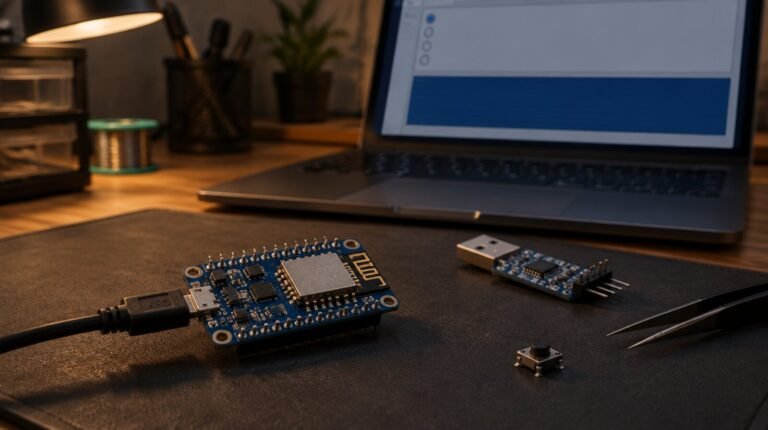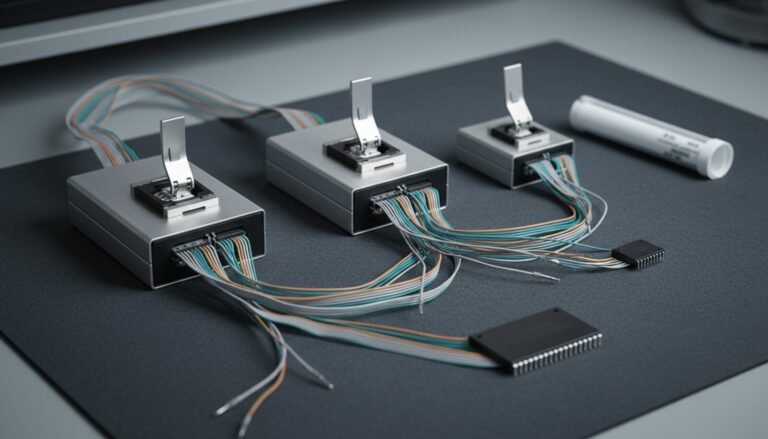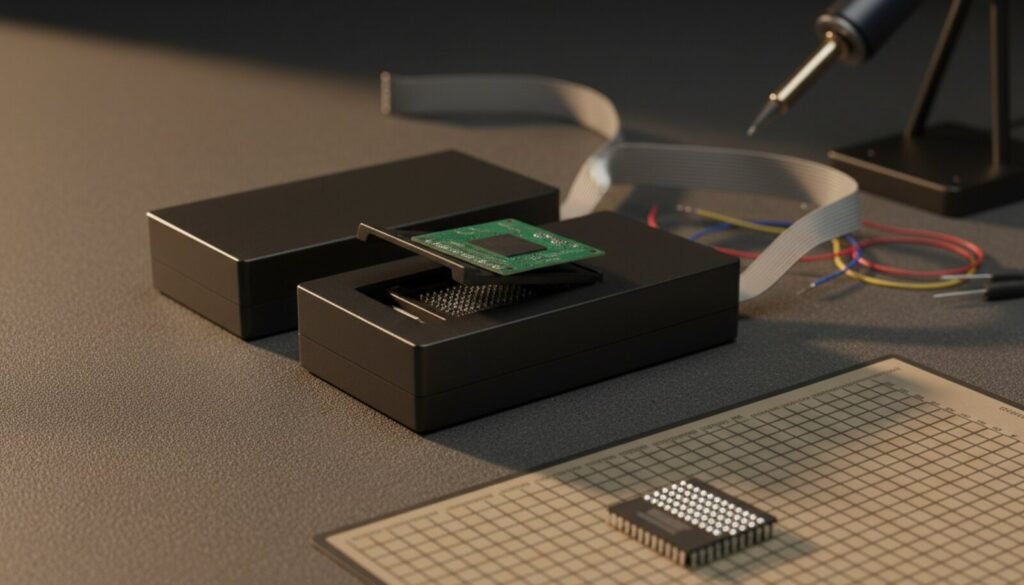
The RT809F and the RT809H look like the same product with a different letter, and they are not. One is a serial/ISP machine built around TV and monitor mainboards; the other is an eMMC and NAND machine that happens to do ISP as well. The official changelogs put numbers on it: 19,531 supported chips for the RT809F against 45,336 for the RT809H — and, more useful than the totals, a completely different distribution of what the two teams spent a decade adding.
⬇ RT809F and RT809H software (iFix, English build 20240116)
Download RT809F software
Download RT809H software
Newer builds exist and are worth taking: RT809F 20250903 and RT809HSE 20250423, both from the same official page (the links there go through Chinese file hosts). Install with administrator rights, and do not plug the programmer in until the software is installed — that order is the vendor’s own instruction. Step-by-step install for each: RT809F guide · RT809H guide.
What each one actually programs
Every row comes from the two official manuals — the feature lists (§1.1.2 for the F, §1.2 for the H), the port descriptions and the packing lists. Where a manual disagrees with a shop listing, the manual wins.
| Capability | RT809F | RT809H |
| Serial EEPROM / SPI flash (24/25/93/95) | Yes, offline | Yes, offline |
| Parallel NOR / PROM (26/27/28/29/30/39/49/50) | Yes | Yes |
| SPI NAND | Yes | Yes |
| TSOP48 / BGA NAND auto-identify + offline read | Yes | Yes |
| Parallel NAND, ONENAND, MCP, EMCP | Not in the device list | Yes, all four listed |
| eMMC as a device (socket, offline) | No | Yes — EMMC_AUTO 8-bit, EMMC_AUTO_4BIT (default), EMMC_AUTO_ISP 1-bit |
| eMMC partitions BOOT / USER / RPMB / GPP | — | Yes, online or offline |
| Laptop EC (IT8, KB90, NPCE, NEC16) | Yes, online and offline | Yes, online and offline |
| VGA ISP out, VGA in, HDMI | Yes | Yes |
| IDC10 ISP header for flying-wire work | Not in the manual’s port list | Yes (MCU ISP and eMMC flying wire) |
| External 9–12 V DC input | No — USB only | Yes, switches automatically with USB |
| Chips with 32 pins or more | Requires the PEB-1 expansion board | Built-in 48-pin socket; HMI port for TSOP56/BGA64 |
| In the box | Programmer, SOP soldering board, USB cable, VGA cable | Same plus a DIP48 soldering board |
| Supported chips (official changelog header) | 19,531 | 45,336 |
| Newest published build | 20250903 | 20250423 |
| Troubleshooting chapter in the manual | None | Chapter Ⅷ, 8.1–8.6 |
The number that decides it: what the changelogs were spent on
Both changelogs are public and complete — the F’s runs from 2011 to 2025, the H’s from 2016 to 2026. Counted on 3 October 2026 (673 usable lines for the F, 709 for the H), they show where a decade of engineering actually went, which no spec sheet does.
| Changelog lines mentioning… | RT809F | RT809H |
| eMMC | 6 | 62 |
| NAND | 10 | 63 |
| TSOP | 3 | 23 |
| BGA | 23 | 42 |
| 1.8 V / 1.2 V low-voltage parts | 2 | 9 |
| ISP | 69 | 29 |
| RTD (Realtek scaler platforms) | 20 | 0 |
| MST (MStar platforms) | 19 | 10 |
| MTK (MediaTek platforms) | 5 | 1 |
| Laptop EC families (IT8, KB9, NPCE, NEC16) | 13 | 7 |
That is the whole argument in one table: the RT809F is the TV-platform ISP tool — Realtek, MStar and MediaTek scaler work, serial printing, EC chips — and the RT809H is the storage tool. Neither is a newer version of the other.
The six eMMC lines in the F’s changelog are the source of most of the confusion online. All six are from 2018 and all six say the same thing: serial-ISP writing of the eMMC boot block on specific MStar TV SoCs (MSD6A338, MSD6A628, MSD6A638, MSD6A828, MSD6A918, MSD6A928), later grouped under one MSTAR_EMMC_BOOT #ISP entry. The F pushes a boot image into a TV through the board’s serial port; it never mounts the eMMC, never sees USER or GPP, and cannot dump one.
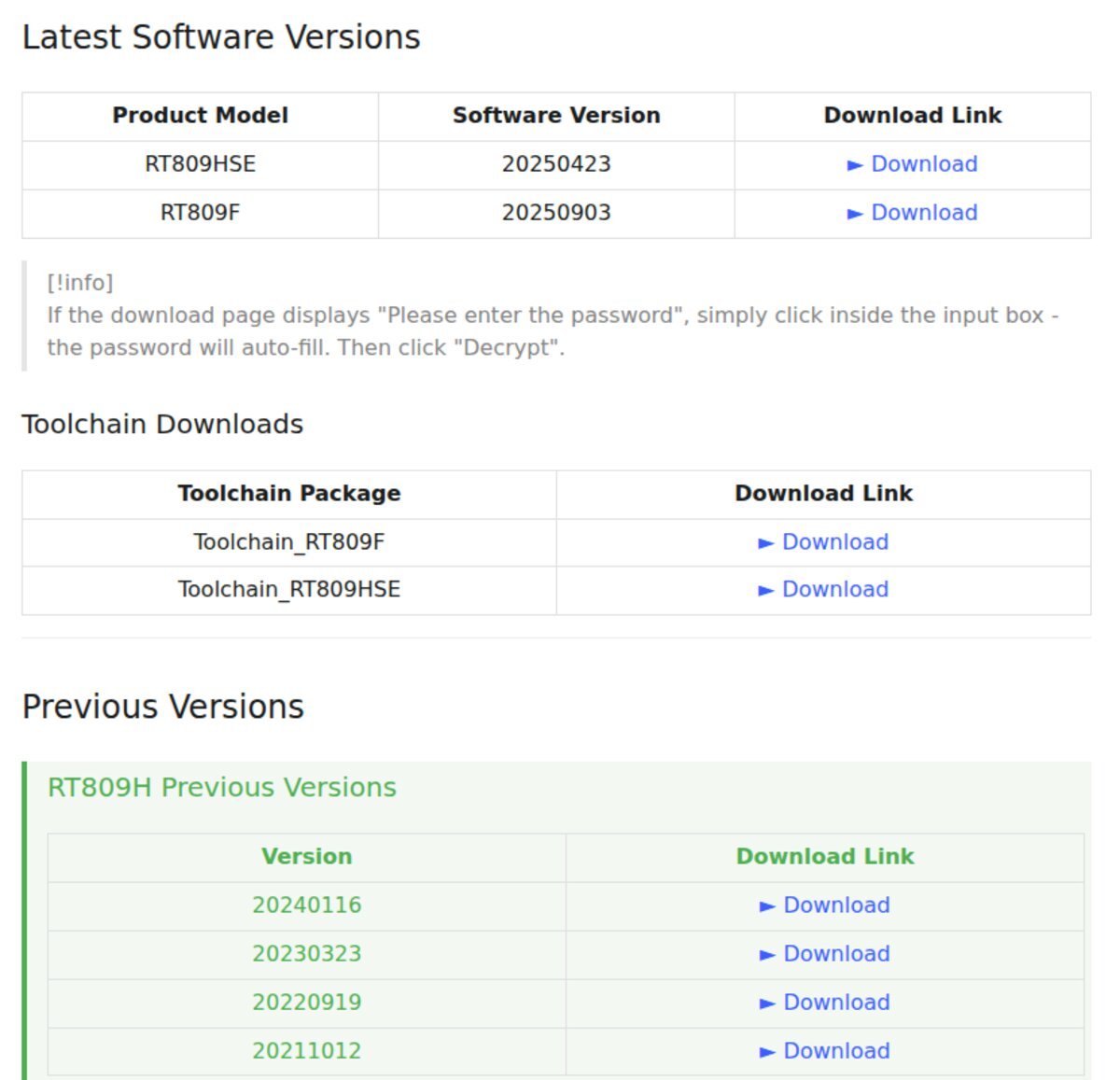
One oddity worth knowing: the H’s log carries a 2026 section — eMMC ceiling raised from 256 GB to 512 GB, EXT_CSD and CID decoding with GPP/ENH capacity display, compressed saving of the USER area, logical-partition read/write marked “in internal testing” — while the newest build you can download for it is 20250423. The F has no 2026 section at all, yet its newest build (20250903) is the fresher binary of the two.
The accessory bill nobody quotes
This is where buyers get caught. The RT809F manual states it plainly: “The chip with 32 pins or more need the PEB-1 expansion board together to do the writing.” PLCC32, TSOP48, NAND, EC chips in TSOP — all of it runs through the PEB-1, and the PEB-1 is not in the packing list (programmer, one SOP soldering board, USB cable, VGA cable). A bare RT809F reads 8-pin flash and little else.
The RT809H ships a DIP48 soldering board as well and has the 48-pin socket on the unit, so TSOP48 is covered out of the box. Its missing piece is the other end: eMMC needs a BGA socket, and the manual insists on the approved one — “Choose the approved EMMC seat, don’t use the third-party seat” — with the chip reballed and cleaned first. Budget for reballing gear too.
Which one for the job in front of you
| The job | Buy | Why |
| LCD TV mainboards: reflash scaler firmware, read serial printing | RT809F | Where its changelog lives — 69 ISP lines, 20 Realtek, 19 MStar, plus VGA ISP and HDMI |
| Smart TV with firmware on eMMC (dump, repair, rewrite) | RT809H | Only it mounts eMMC; EMMC_AUTO_ISP does it with four flying wires in place |
| Laptop BIOS and EC chips | Either — H if the EC is TSOP | Both do IT8/KB90/NPCE/NEC16; the F needs the PEB-1 for anything past 32 pins |
| GPU BIOS, motherboard BIOS, router flash (SOIC8 25-series) | Neither, probably | A CH341A with a test clip costs a tenth as much and does only this |
| Phones, tablets, set-top boxes, car head units (eMMC/EMCP) | RT809H | MCP and EMCP are in its device list and absent from the F’s |
What they cost, and the eBay naming trap
Prices move, so take this as a snapshot of one marketplace, not a quote: on AliExpress on 3 October 2026 the first results page carried 23 offers for the RT809F and 45 for the RT809H, with a median asking price of US$128 for the F and US$273 for the H — roughly 2.1× — plus a long tail of 20-to-50-adapter bundles above US$400 in both. A PEB-1 adds another US$43–100 to the F.
The naming trap is documented by the vendor: “due to eBay platform’s specific trademark requirements, the RT809H model is listed as RT809HSE on eBay. Both models are identical in functionality and specifications.” An RT809HSE listing is not a lesser device — the official download page serves one file for both.
Five problems people hit (and what the manual says)
eMMC reads halfway and stops. §8.5 gives the order: reball and wipe the balls clean, set VCCQ correctly, and if EMMC_AUTO_8BIT fails fall back to EMMC_AUTO_4BIT, then one partition at a time. Always stopping at the same address means the chip is dying.
Flying-wire eMMC does nothing. Three requirements from §5.2.5: stop the main SoC (grounding the two crystal pins is the easy way), keep the wires under 10 cm, and connect only CLK, CMD, D0 and GND — the board powers the eMMC itself.
An eMMC read produced five files instead of one. Normal: above 4 GB the dump is split automatically. Keep the whole folder.
The RT809F will not write a 32- or 48-pin chip. Not a fault — that is the PEB-1 requirement above.
RPMB comes out empty. By design. The manual calls it “the encryption area, the data in it can not come out so don’t have to be chosen.”
FAQ
Is the RT809F discontinued? No. Its most recent software build, 20250903, is newer than the RT809H’s 20250423, and both are sold new.
Can the RT809F read an eMMC at all? No. It can write the eMMC boot block of certain MStar TV platforms through serial ISP, which is not the same thing and will not dump a phone or a set-top box.
Does buying the H make the F pointless? No — the F’s Realtek and MediaTek scaler ISP work has no equivalent in the H’s changelog, which is why TV shops keep both.
Will either replace a TL866II Plus, T48 or T56? Not for MCUs and logic. The RT809 line is a flash, EC and storage family; the XGecu line is a universal-device family. They overlap at 25-series SPI flash and nowhere else that matters.
Sources
- iFix official download page (English) — current builds, previous versions, install warnings, eBay naming note
- RT809F official changelog and RT809H official changelog — chip counts and every entry counted above
- RT809F user manual — §1.1.2 features, §1.1.5 ports, §1.1.6 packing, §4.3–4.4 PEB-1
- RT809H user manual — §1.2 features, §1.4 ports, §1.5 packing, §4.4 eMMC, §5.2.5 eMMC ISP, §8.5 troubleshooting
If you are deciding what to probe before you decide what to buy, start with the board itself: reading a boardview tells you whether the firmware you need is on an 8-pin flash, a TSOP48 or an eMMC — and that answer, not the price, is what picks the programmer.