Three XGecu programmers get compared endlessly on forums and almost always on one number: how many chips each one claims. That number is the least useful thing about them. We downloaded the four official device lists on 2 October 2026 and counted what is inside them — and the counts say the TL866II Plus has four in-circuit entries in its entire database, while the T48 has 5,940.
Here is the short version, then every number with the file it came from.
Buy which, in one line each
- You program DIP parts, 8-pin SPI flash and 8-bit MCUs on the bench. The T48. It is the only one of the three XGecu still sells, it takes the same 40-pin ZIF adapters as the TL866II Plus, and per XGecu’s own timings it finishes a GD25Q128 in 35 s against the TL866II Plus’s 81 s.
- You pull eMMC off phones and set-top boxes. The T56 — it is the only one here with 8-bit eMMC entries, and XGecu rates it at 40 MB/s against the T48’s 17 MB/s. Buy it used and knowingly; see availability below.
- You already own a TL866II Plus and mostly do 27C EPROMs and AVR/PIC. Keep it. The upgrade buys you speed and in-circuit work, not coverage of what you are already doing.
- You are buying new today. Neither the T56 nor the TL866II Plus is sold by XGecu any more, so it is the T48 or the newer T76 — and note that the open-source minipro on Linux covers the T48 and T56 but not the T76.
⬇ XGpro v13.16 — the software all three share
The T76 does not use this build — it has its own installer, Xgpro_T76 V13.25. Installation, driver and firmware-reflash steps are in the XGpro download guide.
What XGecu’s own table says
XGecu publishes a three-way comparison on its product page, and it is better than anything on a retailer listing because it includes timed program-plus-verify figures for three real chips. Reproduced exactly as published:
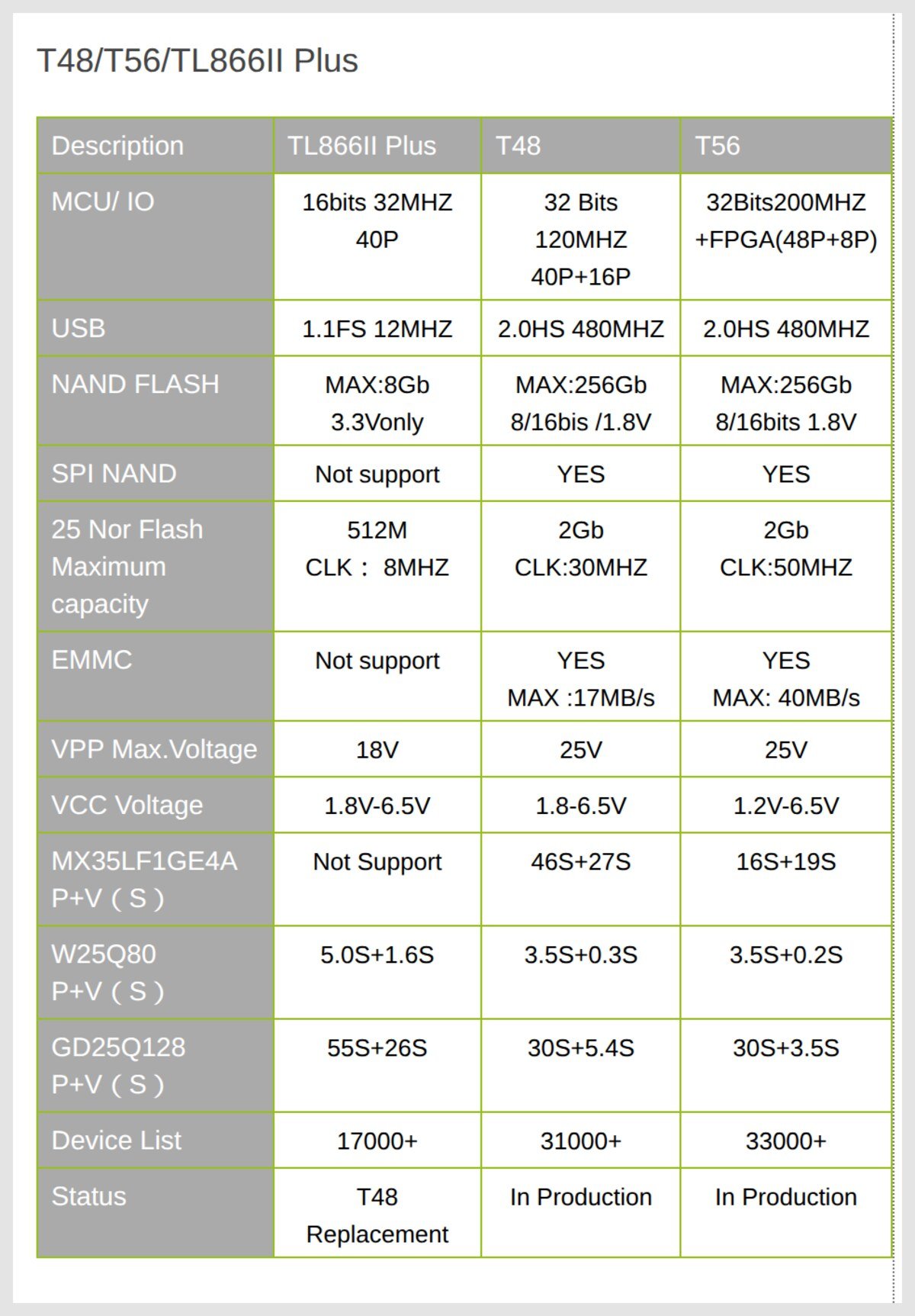
| Per XGecu | TL866II Plus | T48 | T56 |
|---|---|---|---|
| MCU / IO | 16-bit 32 MHz, 40P | 32-bit 120 MHz, 40P+16P | 32-bit 200 MHz + FPGA, 48P+8P |
| USB | 1.1 FS 12 MHz | 2.0 HS 480 MHz | 2.0 HS 480 MHz |
| NAND flash | max 8 Gb, 3.3 V only | max 256 Gb, 8/16-bit, 1.8 V | max 256 Gb, 8/16-bit, 1.8 V |
| SPI NAND | Not supported | Yes | Yes |
| 25-series NOR max | 512 Mb, CLK 8 MHz | 2 Gb, CLK 30 MHz | 2 Gb, CLK 50 MHz |
| eMMC | Not supported | Yes, max 17 MB/s | Yes, max 40 MB/s |
| VPP max | 18 V | 25 V | 25 V |
| VCC range | 1.8–6.5 V | 1.8–6.5 V | 1.2–6.5 V |
| MX35LF1GE4A program+verify | Not supported | 46 s + 27 s | 16 s + 19 s |
| W25Q80 program+verify | 5.0 s + 1.6 s | 3.5 s + 0.3 s | 3.5 s + 0.2 s |
| GD25Q128 program+verify | 55 s + 26 s | 30 s + 5.4 s | 30 s + 3.5 s |
Two rows on that page are stale and we have left them out above: its device counts (17000+/31000+/33000+) and its “In Production” status for the T56. Both are contradicted by XGecu’s own newer pages — see availability, below.
One thing the table settles quietly: the socket. The TL866II Plus and the T48 both carry a 40-pin ZIF (40P, plus 16 ISP channels on the T48); the T56 carries a 48-pin ZIF (48P + 8 ISP). So DIP adapters bought for a TL866II Plus drop onto a T48, and a 48-pin DIP part needs a T56 or an adapter — which is why XGecu’s accessory listings are worded “only for XGecu T56 programmer”.
What the support lists actually contain
Each programmer gets its own device list, published as a plain text file next to the installer. We pulled all four on 2 October 2026 and counted the package suffixes inside them. The totals and manufacturer sections are covered in our XGpro guide; what follows is what nobody counts.
| Counted in the official list | TL866II Plus | T48 | T56 | T76 (context) |
|---|---|---|---|---|
| List version / date in file | V13.16, 17.3.2026 | V13.16, 17.3.2026 | V13.16, 17.3.2026 | V13.25, 28.9.2026 |
| Total devices (file’s own figure) | 19,740 | 37,103 | 40,039 | 42,945 |
| Manufacturer sections | 172 | 173 | 173 | 174 |
@ISP entries (in-circuit) |
4 | 5,940 | 6,100 | 7,116 |
@BGAnnn entries |
33 | 5,422 | 6,762 | 7,411 |
@TSOP48 entries |
2,260 | 2,963 | 3,189 | 3,222 |
| Distinct package suffixes | 98 | 448 | 482 | 853 |
| 8-bit eMMC entries | 0 | 0 | 10 | 10 |
| SD/TF card entries | 0 | 4 | 0 | 4 |
The ISP gap is the real difference
The TL866II Plus has an ICSP header and the manual describes using it, so “no in-circuit support” is wrong. But the database is what the software will actually let you select, and in 19,740 entries exactly four carry the @ISP suffix: PIC16F1526, PIC16F1527, PIC16LF1526 and PIC16LF1527. Another five SyncMOS parts are tagged @ICP only. Nine parts, out of nearly twenty thousand.
On the T48 and T56 the suffix appears on roughly one entry in six. That is the line between a programmer you desolder chips for — see our SOIC-8 clip guide and BGA reballing notes — and one you can clip onto a live board. The T48/T76 manual puts numbers on that path too: in-circuit lines up to 40 cm at 50 MHz, 4-bit eMMC mode running four times faster than 1-bit, and a hard ceiling of 120 mA that the programmer can feed the target board through ICSP_VCC_Enable.
Three things the bigger number hides
The T56 cannot read SD and TF cards; the T48 can. The T48 list carries AUTO-SD/TF_CARD(1Bits) and (4Bits) entries through its SD adapter. The T56 list has none. The T76 brought the feature back. If you dump memory cards, the “lesser” programmer is the one that does it.
The T56 is not a superset of the T48. Both cover the identical 173 manufacturer sections — the T56’s extra 2,936 entries are depth inside brands, not new brands. And in two sections the T48 wins outright: SyncMOS (138 entries vs 92) and Xincun (13 vs 6).
Newer does not mean more. SyncMOS is the clearest case: 205 entries on the TL866II Plus, 138 on the T48, 92 on the T56 and T76. Old 8051-family parts are being dropped as the line moves on. If a specific legacy part is why you are buying, search the list file for it before you spend anything — the lists are free and the search takes a minute.
What you can actually buy in October 2026
XGecu’s English download page now heads the section “(STOP) T56 / TL866II programmer“, and the Chinese page uses 停产 — discontinued. The software matches: the TL866II/T48/T56 build stopped at V13.16 dated 17 March 2026, while the T76 went on to V13.25 on 28 September 2026.
The official store confirms it from the other side. Of 130 products listed on 2 October 2026, 75 mention the T56 or TL866II — and every one is an adapter, a socket or a T76 listing describing itself as their replacement. The only programmers on sale are the T48 from US$49.00 and the T76 from US$139.00. Anything else is channel stock, used, or a clone; XGecu has a standing piracy notice about exactly that happening to the TL866A/CS.
Common problems when choosing or switching
- A 27C EPROM that will not program on a TL866II Plus. The manual is explicit: “TL866II only supports programming voltage VPP up to 18V. For earlier 27C series ROMs, chips with VPP voltage of 21V and 25V are no longer supported for writing, but can be read.” It also warns not to feed external voltage to force it, because 21/25 V can run back into the programmer. The T48 and T56 both reach 25 V.
- “Error when updating firmware, unable to refresh.” Per the official guide this is almost always an external USB hub. Plug the programmer straight into a motherboard port and retry, or reflash on another computer.
- Intermittent failures that look like a dead chip. The guide sets a floor of 4.90 V at the USB port and blames cheap cables and hubs for anything under it. Check before replacing the part.
- “ID Error” on an MCU you know is good. Encrypted microcontrollers will not return an ID; uncheck [Check ID] and the operation proceeds. Full walkthroughs in the TL866II Plus, T48 and T56 guides.
FAQ
Is the T48 or the T56 better? For eMMC and 48-pin DIP parts, the T56. For everything else, the T48 — it is faster than the TL866II Plus by the same order, costs less, reads SD cards, and is the one still in production.
Is the TL866II Plus worth buying in 2026? New, no — XGecu stopped it and marks the T48 as its replacement on its own page. Second-hand and cheap, it is still a capable EPROM, EEPROM and 8-bit MCU programmer.
Do my TL866II Plus adapters fit a T48? The DIP-socket ones do; both machines use a 40-pin ZIF. Adapters sold specifically for the T56’s 48-pin socket do not.
Does any of this work on Linux? The open-source minipro supports TL866CS, TL866A, TL866II+, T48 and T56. XGpro itself is Windows-only. We covered the setup in minipro on Linux.
Sources
- Official device lists, downloaded and counted 2 October 2026: TL866II_List.txt, T48_List.txt, T56_List.txt, T76_List.txt
- XGecu product page — the manufacturer’s own T48/T56/TL866II Plus comparison and timings
- XGecu download page — the “(STOP) T56 / TL866II programmer” heading and the V13.16 / V13.25 split
- Xgpro Software User Guide – T56/TL866II (official, 20 pp.) — parameter lists and the 21 V/25 V VPP warning; Xgpro User Guide – T48/T76 (official) — ICSP current limit and in-circuit figures
- XGecu official store — catalogue and prices read 2 October 2026
- minipro — “Compatibility with TL866CS, TL866A, TL866II+, T48, and T56 from XGecu”
Related guides
- XGpro software download — the installer, driver and firmware reflash, step by step
- TL866II Plus guide · T48 guide · T56 guide
- RT809H guide — the other route to eMMC and TV board work
- CH341A with AsProgrammer — the US$5 alternative, and where it stops