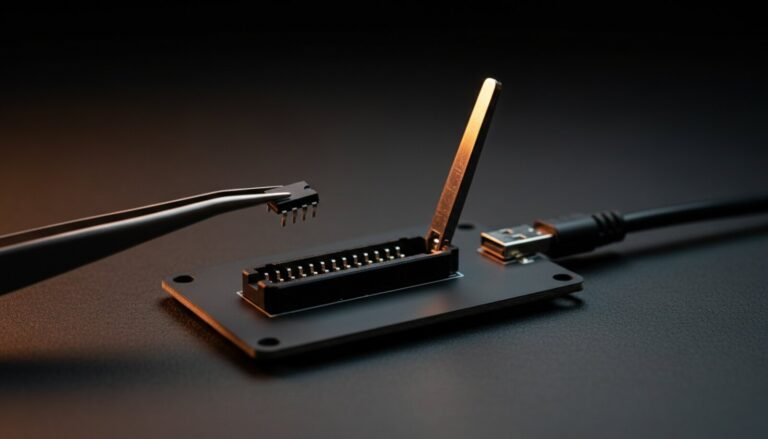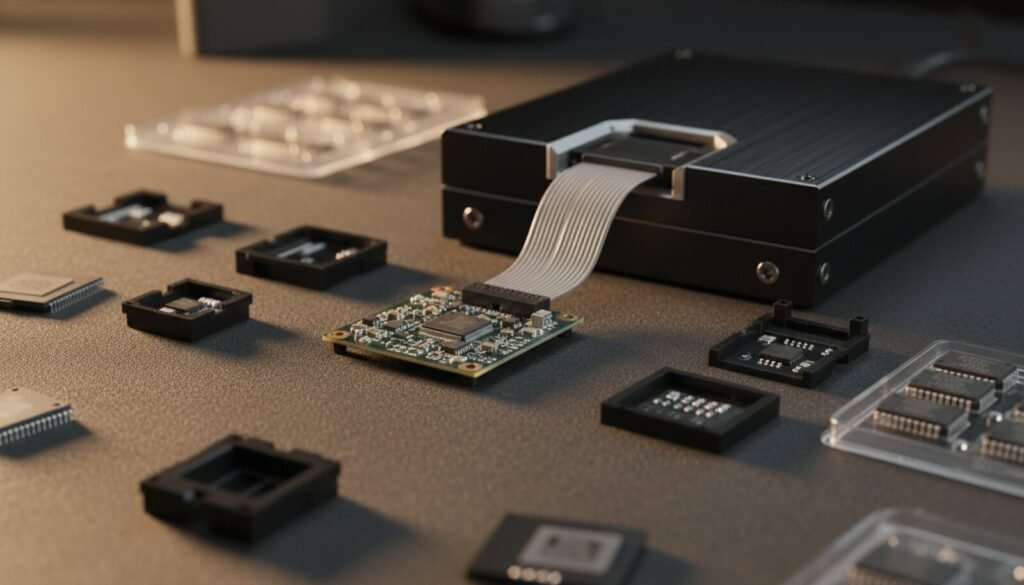
The XGecu T56 is the top of the XGecu range — and the answer to one specific question: “how do I read this NAND / eMMC chip?” Smart TVs, dashcams, tablets, set-top boxes and consoles store firmware on parts the TL866II Plus and T48 simply can’t touch. The T56 can. Here’s what it does, what it costs you in complexity, and how to set it up right.
What the T56 adds
| NAND flash | Parallel NAND (TSOP-48 etc.) — TV mainboards, media players. With bad-block awareness, which is the hard part; |
| eMMC | BGA storage used in tablets, dashcams, consoles — readable in-socket with the right adapter, including partition-aware dumps; |
| 56 pin drivers | Every pin of the ZIF socket is fully driven — that’s why big parallel parts work without the pin-count gymnastics; |
| Everything the T48 does | SPI NOR, EEPROM, MCUs, logic test — same XGpro software, same workflow; |
| ISP | In-system reads for SPI and some eMMC via cable, when desoldering isn’t an option. |
The honest part: adapters are the real cost
The T56 unit itself is only half the purchase. NAND and eMMC parts come in packages (TSOP-48, BGA-153/169, VFBGA…) that each need their own socket adapter — and the good ones aren’t cheap. Budget for the adapters your actual workload needs, not the whole catalog. TV repair? TSOP-48 first. Dashcams/tablets? eMMC BGA-153/169.
Setup and first NAND dump
- Install XGpro v13 — T56 support is native;
- Seat the chip in the adapter, adapter in the ZIF, select the exact part number;
- NAND 101: expect bad blocks — they’re normal, the factory marks them. XGpro lets you choose how to handle them (skip vs include). For a straight clone to an identical chip, “skip bad blocks” both ways is the standard play;
- As always: read and save the original before anything else. With eMMC, dump every partition — boot areas included, not just the user area.
Common questions
Do I need a T56 for BIOS work? No — that’s SPI NOR, and a T48 or even a CH341A handles it. The T56 earns its price only when NAND/eMMC enters your bench.
Can it fix a TV with corrupted firmware? That’s the classic use case: dump the NAND from a donor board (or a firmware archive), write to the patient. The programmer is the easy half — sourcing the correct firmware image is the real hunt.
eMMC in-circuit or off-board? Off-board in a socket is dramatically more reliable. ISP works when the board plays nice, but flying leads to a BGA at eMMC speeds is a coin toss — budget the hot-air time.
Verdict
Specialist tool, specialist price, no real substitute at this cost level. If your bench sees TVs, dashcams or anything with soldered storage, the T56 pays for itself on the first saved board. If not, the T48 is the smarter buy.