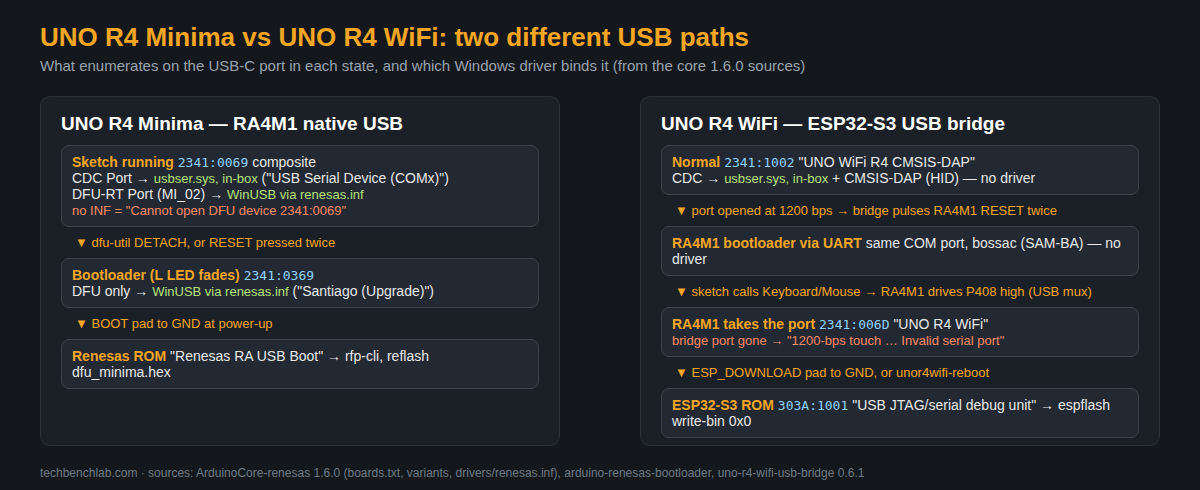
The two UNO R4 boards reach your PC through completely different USB paths, and that is why one of them “needs a driver” on Windows 11 and the other does not. The UNO R4 Minima talks USB from the Renesas RA4M1 itself and exposes a DFU-RT interface that only works once Arduino’s WinUSB INF is installed; the UNO R4 WiFi talks through its ESP32-S3, which enumerates as a plain CDC serial port that Windows binds with its in-box usbser.sys. Almost every “not detected” thread for these boards is one of five situations, and each has a different fix. Everything below was read from the core 1.6.0 sources, the bootloader and USB-bridge repositories, and the forum threads linked at the end.
⬇ Arduino UNO R4 WinUSB driver (from core 1.6.0, mirrored) · dfu-util 0.11 · Zadig 2.9 · UNO R4 WiFi bridge firmware 0.6.1
Download Arduino_UNO_R4_WinUSB_driver_1.6.0.zip (24 KB)
dfu-util 0.11 (GPL-2, mirrored): dfu-util-0.11-binaries.zip · 6,542,684 bytes · SHA-256 8f8055e71d686d412c25696a55eb9011df9120ad1fe9fe1e36a3df595585aea7 · upstream release of 5 Sep 2021 from dfu-util.sourceforge.net, win64 and win32 builds. Arduino’s own build is dfu-util 0.11.0-arduino5 (official tarball, SHA-256 6451e16b…bb641 in package_index.json); it prints “dfu-util 0.11-arduino4” and accepts a -Q flag that upstream 0.11 does not have.
Zadig 2.9 (mirrored): Zadig-2.9.zip · 5,321,281 bytes · SHA-256 a1a653be3be514116eea78fb024bf44cc1927907e54daed29277142c3b60dd5f · official: zadig.akeo.ie.
UNO R4 WiFi USB-bridge firmware 0.6.1, official link only: unor4wifi-update-windows.zip (released 2 Nov 2026, 4,970,736 bytes, SHA-256 dee5afa41297b468227c7e70f6da4581b981d4dacfef3c0d9ab78c8125ba9aba). It contains update.bat, bin\unor4wifi-reboot.exe, bin\espflash.exe and firmware\UNOR4-WIFI-S3-0.6.1.bin; the repository has no license file, so it is linked, not mirrored.
What each board shows in Device Manager, state by state
The IDs come from boards.txt, the two pins_arduino.h files, drivers/renesas.inf, the bootloader makefiles and the bridge firmware; the driver column is what the INF or Windows binds.
| Board / state | USB ID | What enumerates | Driver | How you get there |
|---|---|---|---|---|
| UNO R4 Minima, sketch running | 2341:0069 |
Composite “UNO R4 Minima”: CDC Port (MI_00/01) + DFU-RT Port (MI_02); + HID if the sketch uses Keyboard/Mouse | CDC → usbser.sys in-box (“USB Serial Device (COMx)”); DFU-RT → WinUSB via renesas.inf (“Santiago Firmware Upgrade” under Universal Serial Bus devices) |
Plug it in |
| UNO R4 Minima, DFU bootloader | 2341:0369 |
“Santiago (Upgrade)”, DFU only, L LED fades in and out | WinUSB via renesas.inf |
dfu-util sends DFU_DETACH to the DFU-RT interface, or press RESET twice quickly (magic 0x07738135 at 0x20007FF0) |
| UNO R4 Minima, ROM | — | “Renesas RA USB Boot” | Renesas Flash Programmer (rfp-cli) |
Short the BOOT pad to GND at power-up; reflash dfu_minima.hex |
| UNO R4 WiFi, normal | 2341:1002 |
“UNO WiFi R4 CMSIS-DAP” from the ESP32-S3 bridge: CDC + CMSIS-DAP (HID) | usbser.sys in-box + HID in-box; no driver |
Plug it in |
| UNO R4 WiFi, upload | 2341:1002 |
Same port; the bridge pulses the RA4M1 RESET line twice when the port is opened at 1200 bps, the RA4M1 bootloader then speaks SAM-BA over UART to bossac |
none | Automatic (use_1200bps_touch=true) |
| UNO R4 WiFi, sketch uses Keyboard/Mouse | 2341:006D |
“UNO R4 WiFi” from the RA4M1 itself: the core drives P408 high and the USB mux switches away from the ESP32-S3; the bridge port disappears | usbser.sys + HID in-box |
Any sketch that starts the RA4M1 USB stack |
| UNO R4 WiFi, ESP download mode | 303A:1001 |
Espressif “USB JTAG/serial debug unit” (ESP32-S3 ROM) | CDC → usbser.sys in-box |
Short ESP_DOWNLOAD to GND at power-up, or run unor4wifi-reboot; then espflash write-bin 0x0 |
| Nano R4 | 2341:0074 / 0374 |
Same scheme as the Minima (DFU-RT + DFU) | Same INF, added in core 1.5.x | — |
The driver package, version by version
Arduino installs the driver silently when you add “Arduino UNO R4 Boards” in Boards Manager: post_install.bat runs drivers\dpinst-amd64.exe /SE /SW /SA, and on Windows 7/8 a second pass installs the prewin10 CDC INF. We unpacked every core version in Arduino’s package index to see what changed.
| Core versions | renesas.inf DriverVer |
Boards in the INF | Catalog signed | Note |
|---|---|---|---|---|
| 1.0.2 – 1.2.0 (2023; 1.0.2, 1.1.0 and 1.2.0 checked) | 03/03/2020, 10.48.00.000 | UNO R4 Minima, Portenta C33 (“H33”), Science Kit R3 — 6 IDs | 4 May 2023, Arduino SA (Sectigo) | First package; the Minima is “Santiago” in the strings |
| 1.3.2 – 1.4.1 | same | + Opta Digital / Opta Analog — 10 IDs | 21 Dec 2023 | — |
| 1.5.1 – 1.6.0 (current, 3 Jun 2026) | same | + Nano R4 (0074/0374) — 12 IDs |
19 Feb 2025, certificate valid to 21 Feb 2027 | The package mirrored above |
Three things in that INF explain most of the threads. It installs the in-box winusb.sys through Include = winusb.inf and Needs = WINUSB.NT, so no kernel binary of Arduino’s is loaded; the [Manufacturer] line lists only NTamd64, so Windows on ARM has no matching section; and the UNO R4 WiFi is not in it at all, because it never needs it.
Install or repair the driver on Windows 11 (Minima, Nano R4)
- The normal way: Tools → Board → Boards Manager, install (or remove and reinstall) “Arduino UNO R4 Boards”. When the UAC prompt appears, “Do you want to allow this app from an unknown publisher to make changes to your device? dpinst-amd64.exe”, answer Yes. Declining it leaves the core installed and the driver missing; this exact mistake is the resolved cause in threads 1296468 and 1410522.
- Without the IDE: unzip the package above, open an elevated Command Prompt in the folder and run
pnputil /add-driver drivers\renesas.inf /install. Unplug and replug the board. The DFU-RT interface moves from Other devices to Universal Serial Bus devices. - Check: with the board plugged in you should see a “USB Serial Device (COMx)” under Ports and an entry under Universal Serial Bus devices whose Hardware ID is
USB\VID_2341&PID_0069&MI_02. Press RESET twice: the COM port goes away, the L LED fades, andUSB\VID_2341&PID_0369appears under the same section. - Plan B, Zadig: Options → List All Devices, pick “DFU-RT Port (Interface 2)”, driver WinUSB, Install Driver. This binds the same in-box WinUSB without Arduino’s catalog; confirmed working on x64 in thread 1278045.
The errors in the threads, and what fixed them
| Exact message | Board | Cause | Fix that worked (thread) |
|---|---|---|---|
| “Cannot open DFU device 2341:0069 found on devnum N (LIBUSB_ERROR_NOT_FOUND)” then “No DFU capable USB device available” and “Failed uploading: uploading error: exit status 74” | Minima | The DFU-RT interface has no WinUSB driver, so libusb’s libusb_open() fails (dfu_util.c), dfu-util finds no device and exits with EX_IOERR = 74 |
Install the driver as above (1296468, 1410522, 1390170). Double-tapping RESET does not help by itself: 2341:0369 needs the same INF |
| “Unknown USB Device (Device Descriptor Request Failed)” under USB controllers | Both | Enumeration fails before any driver matters: cable, connector or port | A different USB-C cable (1154878: the fourth cable fixed it; 1317354). See Device Descriptor Request Failed |
| Nothing appears at all; RESET twice does not make the L LED pulse | Both | The RA4M1 bootloader is gone or the chip is held in reset (shorts, external circuitry, damage) | Minima: BOOT pad to GND, flash dfu_minima.hex with rfp-cli; WiFi: open the bridge port at 2400 bps and use rfp-cli -dtr (bootloader README). Threads 1455325 and 1447543 ended without recovery |
| “Cannot perform port reset: 1200-bps touch: opening port at 1200bps: Invalid serial port” / “No device found on COMx” | WiFi | The running sketch uses Keyboard/Mouse, the RA4M1 took the USB mux (2341:006D) and the bridge port the IDE wants is gone |
Press RESET twice, re-select the port, upload (1429747, moderator procedure) |
| Board powers up, no COM port, no Device Manager change, Windows plays no sound | WiFi | The ESP32-S3 bridge firmware is not running | ESP download mode + update.bat from the 0.6.1 updater: unor4wifi-reboot.exe opens HID 2341:1002 to reboot the ESP, then espflash write-bin -b 115200 0x0 UNOR4-WIFI-S3-0.6.1.bin (1309146 ended with a referral to Arduino Support because the board no longer enumerated at all) |
| “A certificate chain processed, but terminated in a root certificate which is not trusted” | Minima | The PC cannot build the chain to “Sectigo Public Code Signing Root R46”, which the catalog is signed under | Reported on a locked-down PC (1452166) and on Windows on ARM (1278045); no clean fix in either thread beyond using another machine |
FAQ
Does Memory Integrity (Core Isolation) block this driver? No reason it should: the package loads only Microsoft’s own winusb.sys. In thread 1452166 turning Memory Integrity off changed nothing.
Windows 11 on ARM (Snapdragon X)? The INF has no NTarm64 section, so DPInst and pnputil have nothing to install, and Zadig’s x86 build cannot install drivers under ARM64 emulation (libwdi issue 155). The forum report on a Galaxy Book4 Edge ends with the Minima unusable and the ESP32 working through Silicon Labs’ INF (1278045). Microsoft’s own WinUSB sample INF lists NTamd64,NTarm64; Arduino’s does not yet.
Why does the Minima need a driver when the WiFi does not? Because uploads to the Minima go over USB DFU, which Windows has no in-box class driver for, while uploads to the WiFi go over a plain CDC serial port handled by the bridge.
Can I use upstream dfu-util instead of Arduino’s? The upload line is dfu-util --device 0x2341:0x0069,:0x0369 -D sketch.bin -a0 -Q; with the mirrored upstream 0.11 drop the -Q (use -R to reset), which is the line Arduino left commented in platform.txt.
Related guides
- Arduino IDE 2: port not showing, board by board
- “USB Serial Device”: which boards bind usbser.sys with no vendor driver
- STM32 DFU driver on Windows 11: Zadig and dfu-util
- Pro Micro / Leonardo: the 8-second bootloader port
- Zadig: WinUSB, libusb-win32 and libusbK explained
- ESP32 board USB driver hub (native USB JTAG/serial included)
- COM port busy / Access is denied
Sources
- ArduinoCore-renesas: boards.txt (IDs,
upload.tool=dfu-util/bossac,use_1200bps_touch), platform.txt, drivers/renesas.inf, post_install.bat - cores/arduino/usb/USB.cpp (“CDC Port”, “DFU-RT Port”,
configure_usb_mux()), variants/UNOWIFIR4/variant.cpp (P408 “USB switch, drive high for RA4”), MINIMA/pins_arduino.h and UNOWIFIR4/pins_arduino.h (USB_PID0x0069 / 0x006D) - bootloaders/UNO_R4/README.md (ESP download mode, 1200/2400 bps, “Renesas RA USB Boot”, rfp-cli); arduino-renesas-bootloader src/main.c (double-tap magic, “ONLY DFU”, LED fade) and Makefile.minima (
USB_PID=0x0369) - uno-r4-wifi-usb-bridge: UNOR4USBBridge.ino (VID/PID 2341:1002, product name, 1200/2400 bps handling), unor4wifi-reboot/main.go, releases (0.6.1, 2 Nov 2026)
- package_index.json (core versions, checksums, dfu-util 0.11.0-arduino5)
- dfu-util src/dfu_util.c (“Cannot open DFU device … (%s)”) and src/main.c (“No DFU capable USB device available”,
EX_IOERR); sysexits(3) (EX_IOERR = 74) - Microsoft Learn: WinUSB installation (USBDevice class,
NTamd64,NTarm64sample); libwdi issue 155 (Zadig on ARM64) - Arduino Forum: 1296468, 1410522, 1390170, 1452166, 1317354, 1154878, 1309146, 1429747, 1278045, 1447543, 1455325